
A practical look at the skillset of a modern PM for digital and physical platforms
When I recently spoke with a PM from a large bank, he told me something that stopped me in my tracks: "I only use AI for writing emails." Meanwhile, his competitors are already achieving 40% higher productivity thanks to AI integration throughout the entire product process. In five years, this difference will be existential.
Data from McKinsey, Gartner, and BCG are unequivocal. 72% of data leaders fear their organizations will lose competitive advantage if they don't adopt AI. Yet most product managers still work with methods from 2020.

The Problem: Traditional PM Approach Is No Longer Enough
The gap between AI-first and AI-laggards is dramatically widening. McKinsey data shows that the gap in AI maturity between leaders and laggards has increased by 60% over three years. Digital and AI leaders today achieve 2-6× higher total shareholder return than their competitors.
The risks of non-adoption are concrete and measurable. Product managers without AI competencies face 40% lower productivity, 5% slower time-to-market, and growing inability to compete with teams that integrate AI into everyday work.
Companies that don't invest in AI competencies for their PM teams are falling into a stagnation trap. While their competitors automate routine tasks and use AI for strategic decisions, they remain trapped in manual processes that are increasingly expensive and slower.
The Solution: Five Key AI Competencies for Modern PMs
According to research from McKinsey, Gartner, and Product School, every product manager needs to master five fundamental areas. It's not about becoming a data scientist, but about understanding AI well enough to use it strategically.

AI & Data Literacy means understanding how AI models work, what data they need, and where they can fail. It's not about technical details, but about the ability to identify which problems are suitable for AI solutions and how to ensure output quality.
Analytical Thinking & AI-Powered Decisions represents a transition from intuitive decision-making to a data-driven approach. Modern PMs must be able to interpret AI analyses, design experiments for AI-driven features, and translate AI outputs into product strategy.
AI Tool Fluency & Integration includes practical knowledge of generative AI tools from ChatGPT to specialized PM platforms. It's about the ability to integrate these tools into daily workflow and use them to automate routine tasks.
Strategic AI Product Development is about designing products that use AI as a competitive advantage. PMs must be able to balance accuracy, latency, costs, and user experience when working with data science and ML teams.
Responsible AI Awareness covers ethical aspects, bias management, and compliance with regulations. In an era where AI decisions affect millions of users, responsibility for transparency and fairness is crucial.
Results: Measurable Business Impact
The numbers speak clearly. A McKinsey study showed 40% increase in PM productivity when using generative AI tools and 5% acceleration in time-to-market across a six-month product cycle. All study participants reported 100% improvement in customer experience.
At the macroeconomic level, AI can contribute 0.5-0.9 percentage points to annual productivity growth by 2030. Companies that commit to AI transformation can achieve 15-20% improvement in digital maturity over 2-3 years and 10-20% EBIT growth in targeted domains.

Case Studies: Concrete Numbers from Practice
The best evidence comes from companies that took AI integration seriously. Their results show what's possible when AI becomes part of the product team's DNA.
Klarna: Warning Against Hasty AI Implementation
Klarna became a textbook example of how NOT to bring AI into product processes. In 2022, it laid off 700 employees and replaced them with AI systems. CEO Sebastian Siemiatkowski claimed AI could handle everything from customer support to executive decisions.
Reality was different. By 2024, Klarna faced rising customer complaints, declining satisfaction, and user frustration with generic AI responses. AI systems failed at more complex problems requiring empathy and human understanding. The CEO later admitted: "We went too far," and the company is now actively rehiring human employees.
Toyota: Thoughtful AI Integration
Toyota represents the opposite approach - thoughtful AI integration. It uses AI to optimize production and saved 10,000 hours annually through automation. Generative AI replaces physical manuals, bringing material savings across millions of vehicles. A hybrid cloud approach to AI infrastructure also reduces facility investments.
General Mills: AI as a Tool, Not a Replacement
General Mills implemented AI models for supply chain optimization and achieved $20+ million in savings since fiscal year 2024. Real-time production performance data brings planned waste reduction of $50 million and 20-30% reduction in production waste, representing nearly $20 million in annual savings. The key is that AI is used as a tool to improve human decision-making, not as their replacement.
The Future: Framework for AI-Enabled PM
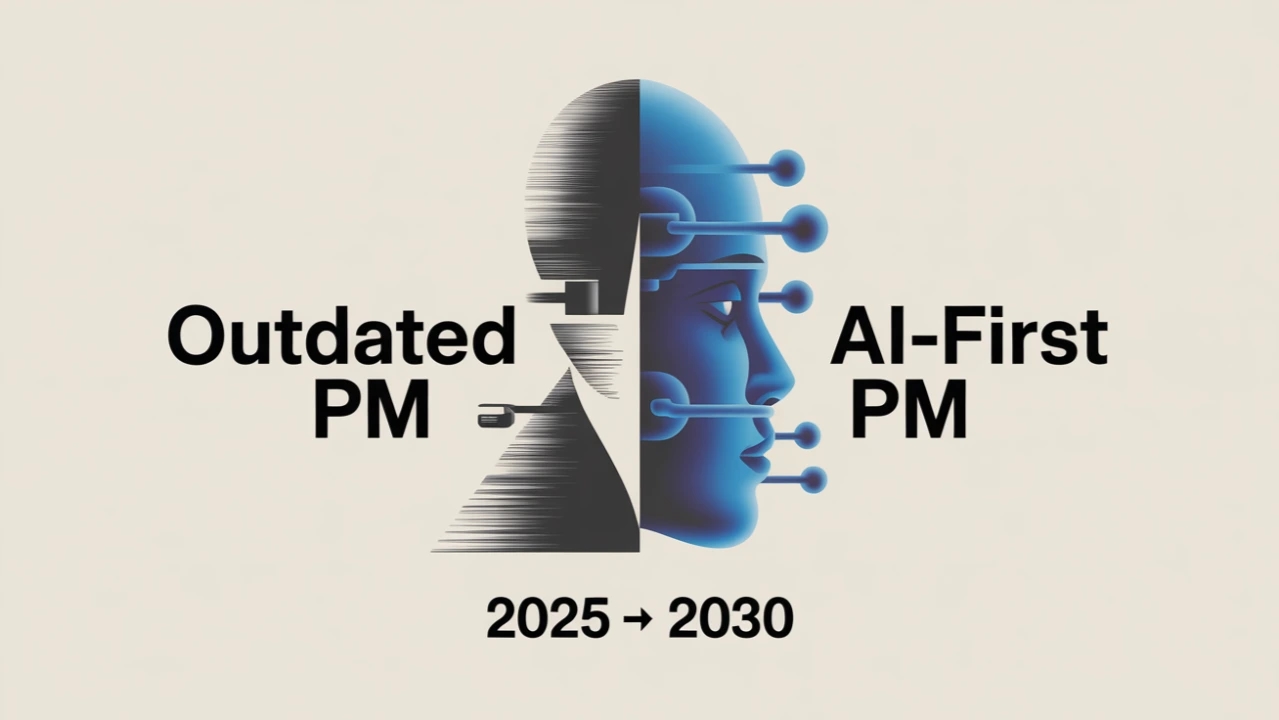
The transformation of product management isn't just about tools, but about a fundamental mindset shift. By 2030, all product managers will de facto be AI product managers. The difference will be in who starts investing in these competencies now.
The future PM framework combines traditional business acumen with AI fluency, customer insights with agile leadership. It's not about replacing existing skills, but expanding them with an AI dimension.
Challenge for Leadership
The time to act is now. Every month of delay means a bigger gap that will need to be closed. Those who don't start investing in AI skills for their PM teams today will face an existential problem in five years.
Concrete steps are clear: invest in AI upskilling for PM teams, redefine hiring criteria for AI-fluent candidates, equip teams with the right AI tools, and create a culture of AI-driven decision-making.
The question isn't whether AI will become standard in product management. The question is whether you'll be among those who lead this change, or among those who play catch-up.