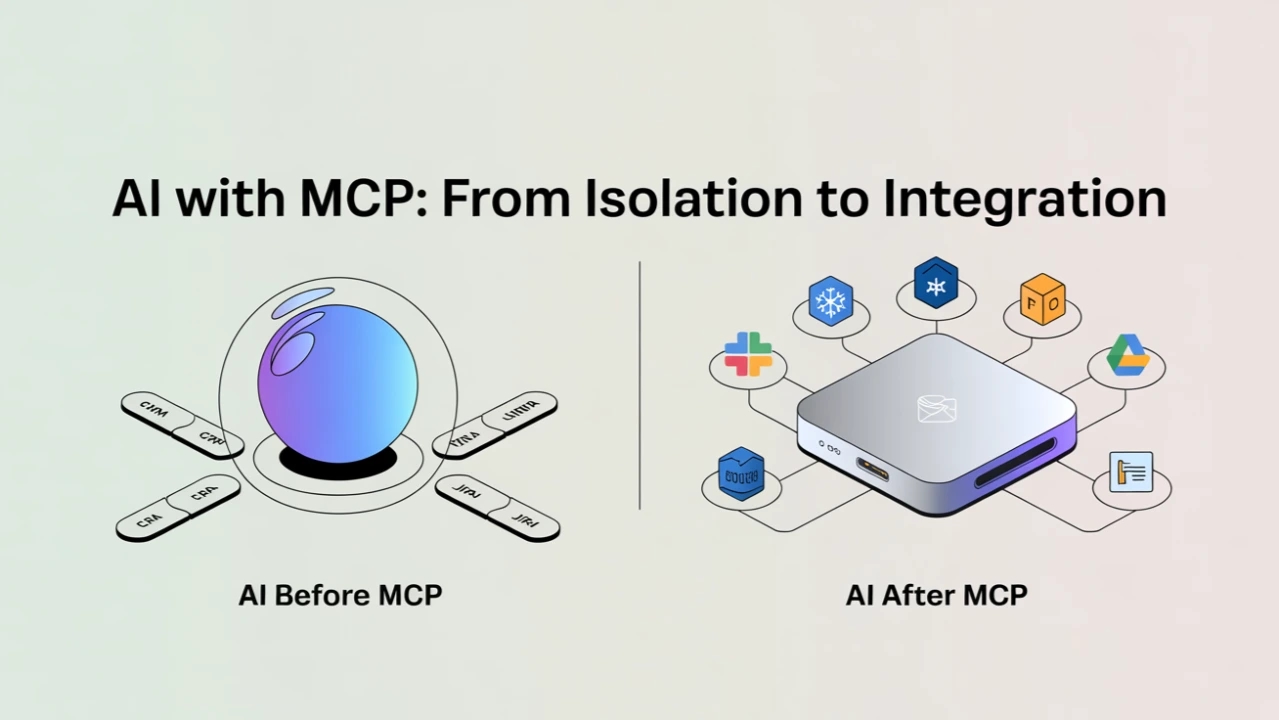

AI models are isolated. Each system has its own API, every integration requires custom development, and the result? Your AI assistants are like brilliant interns who can do everything but don't have access to company systems. Instead of AI actually automating processes, it just writes nice emails about what it could do if it had access to the data.
This problem costs companies millions. According to a Gartner study, knowledge workers spend 40% of their time searching for and preparing data instead of doing actual work. AI could change that – if it could access that data.
The Solution: MCP as a Universal Translator
Model Context Protocol, which Anthropic open-sourced last November, solves this problem elegantly. It functions as a standardized "translator" between AI and your systems.
Imagine it this way: Previously, connecting AI to enterprise systems was like building bridges – each system needed its own unique bridge. MCP is like building a universal port where any ship (AI model) can dock and communicate with any warehouse (enterprise system) using a standard protocol.
Technically speaking, MCP creates standardized "servers" that expose data and functions from your systems in a way that AI models understand. Instead of dozens of custom integrations, one standard is enough.
Real Results: Numbers That Speak for Themselves
Block (formerly Square) deployed MCP in their internal AI platform Goose for thousands of employees. The result? 50-75% time savings on routine tasks. Employees can now ask AI in natural language to analyze data from Snowflake, update tickets in Jira, or coordinate via Slack – all in one conversation.
Microsoft demonstrated MCP's power with their AI Travel Agents application, which orchestrates multiple AI agents for planning complex business trips. The system combines real-time data about flights, hotels, and user preferences.
According to an IDC study, companies using MCP achieve an average 300% ROI with payback in just 6 months. Gartner predicts that by 2026, 75% of API gateway vendors and 50% of iPaaS platforms will support MCP.

My Experience: Why MCP Caught My Attention (and What to Watch Out For)
When I first saw MCP in action, I felt like I was watching Steve Jobs unveil the first iPhone. Finally, someone solved a problem everyone knew about but no one wanted to tackle – the fragmentation of the AI ecosystem.
What excited me:
-
Simplicity of concept: One standard insteadExecutive Summary
-
Model Context Protocol (MCP) is a breakthrough that finally connects AI with the real world of your data and systems – think of it as a USB-C port for artificial intelligence, allowing any AI model to connect to any enterprise system without complex custom integrations.
-
The Problem: AI Lives in a Bubble
-
You may have noticed that while ChatGPT or Claude can write a poem or explain quantum physics, when you need them to help analyze sales data from your CRM or update project status in Jira, you hit a wall. Why?
-
of 20 different integrations
-
Speed of implementation: Block deployed the system for thousands of people in months, not years
-
Openness: Open-source approach means you're not dependent on a single vendor
What to watch out for:
-
Security: MCP opens new possibilities but also new security risks. Prompt injection and "tool poisoning" are real threats
-
Complexity at scale: For small companies, MCP is great, but enterprise deployment requires careful planning
-
Competing standards: Google has already launched the competing A2A protocol – the market is still forming
Conclusion: A Bridge to a Future Where AI Actually Works
MCP isn't just another technical novelty. It's a bridge between a world where AI just talks and a world where AI actually does. Imagine an employee who can launch sales data analysis, update CRM, schedule a meeting, and send a report with a single request – all in natural language.
For decision makers, this means:
-
Dramatic increase in knowledge worker productivity
-
Reduced costs for custom AI integrations
-
Competitive advantage through faster deployment of AI solutions
The question isn't whether MCP or a similar standard will win, but whether you'll be among the first to leverage its potential.