Lmql
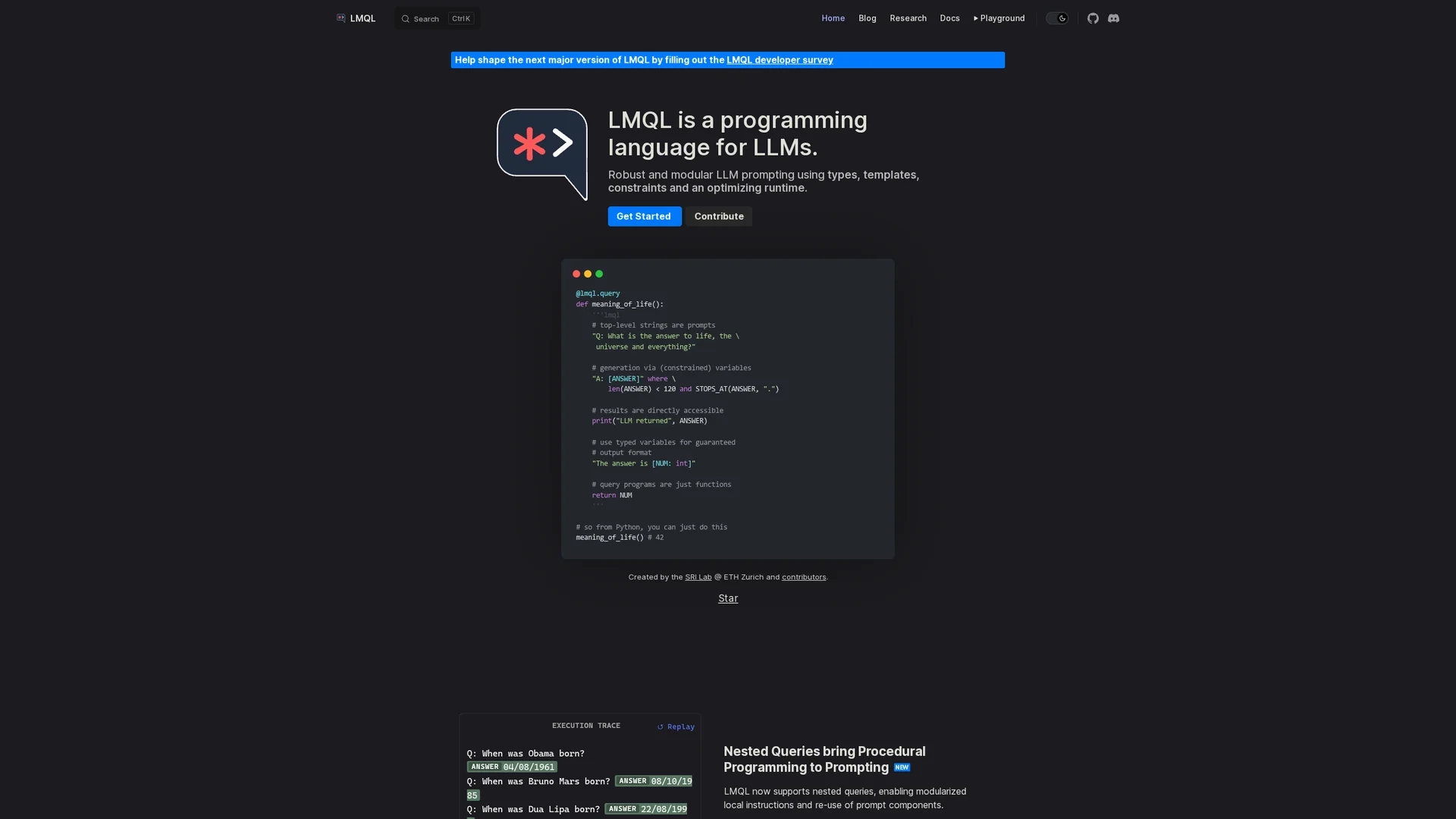
LMQL is a programming language designed for Large Language Models (LLMs), offering modular prompting, nested queries, and seamless backend portability for flexible LLM interaction.
Disclaimer: Visionary Hub is not affiliated with, endorsed by, or the operator of this tool. All trademarks, logos, and content are the property of their respective owners. Full disclaimer available here
Key Features
Typed Prompts
Supports types and constraints to structure prompt inputs and outputs.
Nested Queries
Allows procedural programming by modularizing prompt instructions.
Optimizing Runtime
Executes prompts efficiently with runtime optimizations.
Cross-Backend Support
Ensures portability across different LLM platforms seamlessly.
Get Started
Share & Save
Share on Social Media
Why Choose Lmql
Modular Prompts:
Enables reusable prompt components with nested queries for complex tasks.Backend Portability:
Switch between multiple LLM backends with a single line of code.Python Integration:
Uses Python control flow and string interpolation for flexible prompt creation.
Pricing
For current prices, visit the official page.
About Lmql
LMQL is a programming language designed for Large Language Models (LLMs), offering modular prompting, nested queries, and seamless backend portability for flexible LLM interaction.
What Lmql Does
LMQL enables users to create structured prompts for LLMs using types, templates, and constraints, enhancing the precision and control of language model outputs. It benefits users by supporting complex procedural programming tasks within prompts.
The tool features nested queries for modular prompt components and an optimizing runtime that ensures efficient execution. It supports seamless switching between various LLM backends with minimal code changes, using expressive Python control flow and string interpolation for prompt generation.
LMQL is suitable for software developers, data analysts, and researchers working on tasks that require advanced LLM interaction, such as natural language processing, data analysis, and AI research.
Pros & Cons
Flexibility
Supports complex prompt programming with modular and nested queries.
Portability
Easily switch between LLM backends without rewriting code.
Learning Curve
Requires programming knowledge to fully utilize its features.
Limited Pricing Info
No clear pricing details publicly available.
Frequently Asked Questions
LMQL is used to create modular, typed prompts and procedural programs for Large Language Models.
Yes, LMQL allows seamless switching between different LLM backends with minimal code changes.
Pricing details are not explicitly provided; visit the official page for current information.
LMQL integrates with Python using control flow and string interpolation for prompt construction.
Documentation and community support are available via the LMQL website, GitHub, and Discord.
Similar Tools You Might Like
Discover more AI-powered tools that complement your workflow
List Your AI Tool & Reach Thousands of Users
Join 500+ AI innovators already thriving on our platform. Get visibility, feedback, and boost your conversions.
Expand Your Audience
Connect with over 50,000 AI enthusiasts actively looking for tools like yours.
Boost Your Authority
Get verified reviews and ratings to build credibility in the AI marketplace.
Drive Conversions
Our premium placements and targeted audience deliver quality leads and sign-ups.